
The Quantum Jumper
A sales pitch for pan-dimensional knitwear

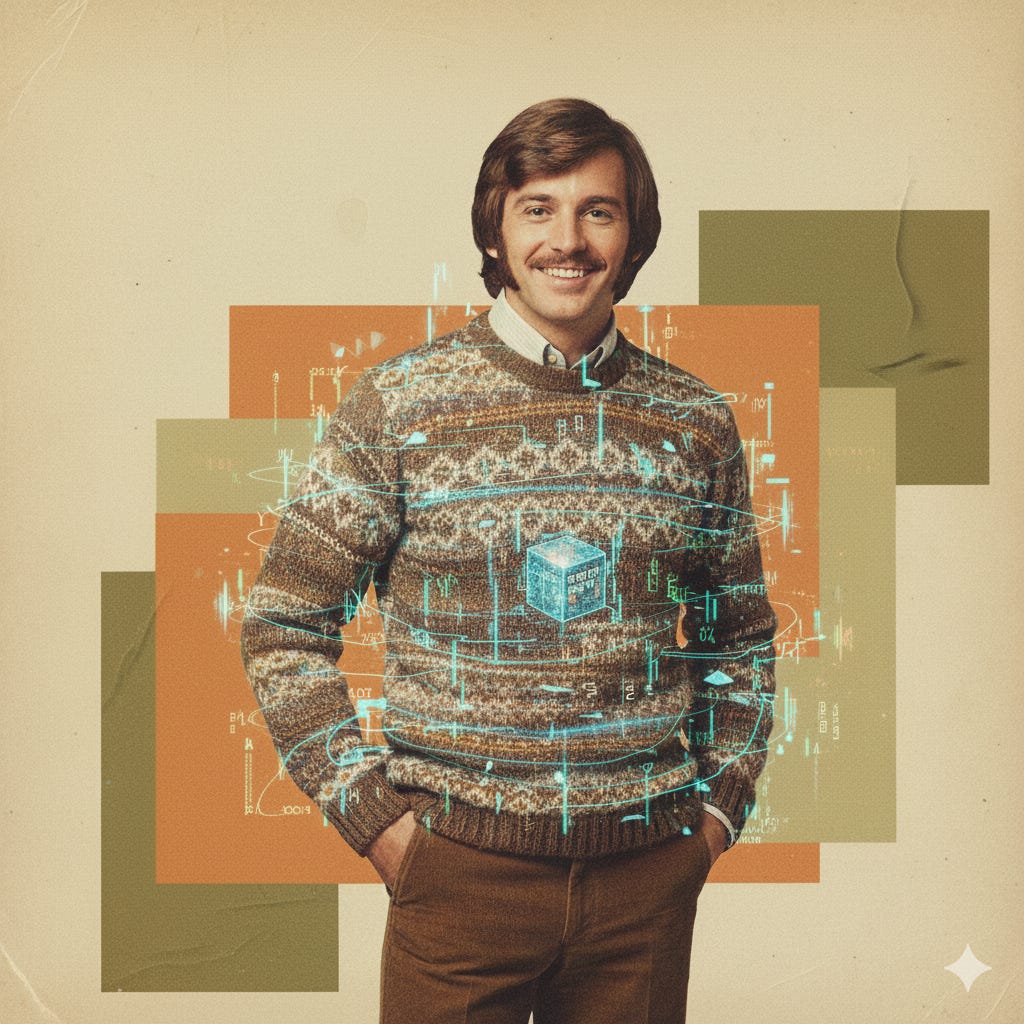
Within the fashion industry, we value adaptability. Transitional clothing that lends itself to layering. Investment pieces that will withstand the fickleness of passing trends and take you into the next season in style. But what if there was a particular article that was woven from the fabric of different realities? An item that could switch between dimensions as well as weather patterns and dress codes.
Hold that thought.
To understand how far you can push a pullover, it helps to know that the histories of clothing and computing are strangely intertwined. As it happens, the introduction of Joseph Marie Jacquard’s eponymous automated loom didn’t just revolutionise the textile industry. Patented in 1804, the Jacquard machine used a system of punch cards in a continuous chain to control a loom head and weave complicated patterns, simplifying and speeding up what had previously been a challenging, slow and labour-intensive procedure. Industrious clothes, made in an industrious way, for the industrial age.
Some three decades later, the English mathematician, inventor and mechanical engineer Charles Babbage – egged on by Ada Lovelace, the mathematician, writer and daughter of the poet Lord Byron – proposed using a similar system, only to crunch numbers instead of yarn. Babbage came up with what he called the analytical engine, a mechanical digital calculation machine. The first computer. And using those punch cards, Lovelace is credited with composing the world’s first algorithm.
“What if the answer isn’t yes or no but yes and no? How do you have your cake and eat it?”
By the early 20th century, IBM’s 80-column format of punch cards – a descendant of Jacquard’s machine – had become the standard for storing digital information. And while the magnetic disks of the 1980s eventually made the physical cards themselves obsolete, Babbage and Lovelace’s basic concept persists. On every laptop, tablet and smartphone.
Even today, binary, or “classical”, computers work on the principle that all calculations – when broken down into small enough pieces – can be ultimately solved with a simple answer: one or zero. Yes or no. All or nothing. And from the analytical engine, which was never actually built in Babbage’s lifetime, right up to contemporary computer programmes that are able to beat all human opponents at chess, shogi and go, binary code is the common language. DeepMind’s all-conquering AI-powered AlphaZero, for example, may think in probability judgements based on floating-point numbers (who doesn’t?), but it speaks in ones and zeroes as that’s all its hardware can handle.
However, what if the answer isn’t yes or no? Or, rather, what if the answer is yes and no. Such as: no, your partner would not like to see the dessert menu and yes, they will have some of yours, thank you. How do you have your cake and eat it?
***
Erwin Schrödinger, the Austrian theoretical physicist, you may have heard of. His conceptual cat, certainly. Although not a certainty, because a lack of that is the focus here. The hypothesis is that, at a sub-atomic level, it was possible – but not necessarily probable – for something to be in several states at once, provided it remained unobserved. Schrödinger’s example was that a cat in a box that contained poison was both alive and dead until you opened the box. Hopefully with a vet on standby.
Sound ridiculous? That’s the point. Schrödinger believed that this concept, known as a quantum superposition, was bunkum, so posed a thought experiment involving the mixed fortunes of a theoretical feline – no real animals were harmed, at least not in our reality – to illustrate as much. Only that backfired, since this hypothetical abstraction is what he is today best known for. (Which might be the best outcome for Schrödinger, given the other allegations that could be his legacy. Google it. Or perhaps don’t.)
And if this idea of something being both one thing and another frazzles your brain, imagine how classical computers, that deal in absolutes of one or zero, feel.
Classical computers work in bits, binary digits, as a unit of information. And calculations in binaries, as anyone who has ever tried to have a nuanced conversation on whatever is left of Twitter can tell you, can be limiting. Step forward a new generation of “quantum” computers that understand the world in another format entirely – qubits, “quantum bits”, which can be one or zero or any combination of both.
“Such is the complexity of a quantum computer that even its makers aren’t entirely sure how the machine functions”
By employing mind-mashing quantum mechanics, these computers are able to perform some tasks and calculations exponentially faster than any modern classical machine – potentially processing data at 100 million times the speed. What does that even mean? Well, a problem that it’s estimated would take today’s most advanced classical supercomputer 10,000 years to work out was recently reportedly resolved by Google’s Sycamore system in under four minutes.
Such is the complexity of a quantum computer that even its makers aren’t entirely sure how the machine functions. There are those who believe that these devices may actually be borrowing processing power from another dimension.
And just as a quantum computer doesn’t work like a classical computer, it doesn’t look like one, either. In the flesh – the copper, silver and gold – it’s more akin to a steampunk chandelier or a mechanical Art Deco jellyfish hanging from inside a sealed box. Its components need to be kept as close to absolute zero as possible, in dust-free conditions, in order to run effectively.
Squint and there’s the faint echo of an early Jacquard loom in there, with its mechanism exposed. But what if there was more to this than a spiritual ancestry and a passing likeness?
***
To complete the circuit, then, if you were to jack up a Jacquard machine to a quantum processor, what manner of clothing could you conjure up? If the binary punch cards of these looms were replaced with the possibilities of the Sycamore and its ilk. An item that wasn’t so much woven as entangled at a sub-atomic level. Linking the particles within articles of clothing using what Albert Einstein called “spooky action at a distance”.
Imagine a sweater, only better. It could exist in several states, only landing on a form when someone glanced over and said, “Nice jumper/cardigan/vest/kirtle [depending on the situation] – where did you get it?” (Now that’s a good question.)
Don’t like a particular wave function? Switch it up for a houndstooth check or a fetching plaid. It’s not just directional, but superpositional.
For colder days, embrace thermodynamics to ensure your quantum knitwear keeps you toasty. As your jumper reacts to its environment, its fuzzy state begins to collapse, resulting in a process called decoherence to heat you up. Too hot? Your sweater will adapt with a breezier weave pattern.
Forget your Fitbit, tell your Apple watch to do one (or zero) – this is proper wearable tech.
Dry clean only.